Learn About my
Publications
Pioneering Research in AI, Security, and Global Norms
Explore My Work
Stay up to date with my latest research contributions, ranging from books to journal articles and more.
Journal Articles
Here’s a selection of peer-reviewed articles. For a full list of publications, see below.
Technologische Herausforderungen: Künstliche Intelligenz, Normativität, Normalität und Praktiken jenseits des öffentlichen Raums
By: Ingvild Bode and Hendrik Huelss
Published in: Zeitschrift für International Beziehungen
Date: 2023
English abstract
The increasing importance of artificial intelligence (AI) in many areas of politically relevant decision-making leads to new questions regarding the role of norms. Existing norm research offers important, diversified concepts, particularly on the emergence, impact and change of norms in the public-discursive space. However, the perspective on operational practices beyond the public space has so far hardly been comprehended theoretically. In the context of analysing military applications of AI, this contribution argues, first, that practices of developing and using AI technologies carried out by various actors beyond the public sphere are important and currently under-theorized sources of normativity. Secondly, it emphasises the interplay between normativity, i.e. ideas about moral duties and justice, and normality, i.e. ideas about the typical and average, in the emergence and development of norms. The theoretical reflection in this contribution offers IR norm research a broader analytical view of the constitution of normative space.
The article is in german.
Machine guardians: The Terminator, AI narratives and US regulatory discourse on lethal autonomous weapons systems
By: Tom Watts and Ingvild Bode
Published in: Cooperation & Conflict
Date: September 2023
Abstract
References to the Terminator films are central to Western imaginaries of Lethal Autonomous Weapons Systems (LAWS). The puzzle of whether references to the Terminator franchise have featured in the United States’ international regulatory discourse on these technologies nevertheless remains underexplored. Bringing the growing study of AI narratives into a greater dialogue with the International Relations literature on popular culture and world politics, this article unpacks the repository of different stories told about intelligent machines in the first two Terminator films. Through an interpretivist analysis of this material, we examine whether these AI narratives have featured in the US written contributions to the international regulatory debates on LAWS at the United Nations Convention on Certain Conventional Weapons in the period between 2014 and 2022. Our analysis highlights how hopeful stories about what we coin ‘machine guardians’ have been mirrored in these statements: LAWS development has been presented as a means of protecting humans from physical harm, enacting the commands of human decision makers and using force with superhuman levels of accuracy. This suggests that, contrary to existing interpretations, the various stories told about intelligent machines in the Terminator franchise can be mobilised to both support and oppose the possible regulation of these technologies.
Practice-based and public-deliberative normativity: retaining human control over the use of force
By: Ingvild Bode
Published in: European Journal of International Relations
Date: April 2023
Summary
The debate about lethal autonomous weapons systems (LAWS) characterises them as future problems in need of pre-emptive regulation, for example, through codifying meaningful human control. But autonomous technologies are already part of weapons and have shaped how states think about human control. To understand this normative space, I proceed in two steps: first, I theorise how practices of designing, of training personnel for, and of operating weapon systems integrating autonomous technologies have shaped normativity/normality on human control at sites unseen. Second, I trace how this normativity/normality interacts with public deliberations at the Group of Governmental Experts (GGE) on LAWS by theorising potential dynamics of interaction. I find that the normativity/normality emerging from practices performed in relation to weapon systems integrating autonomous technologies assigns humans a reduced role in specific use of force decisions and understands this diminished decision-making capacity as ‘appropriate’ and ‘normal’. In the public-deliberative process, stakeholders have interacted with this normativity by ignoring it, engaging in distancing or positively acknowledging it – rather than scrutinising it. These arguments move beyond prioritising public deliberation in norm research towards exploring practices performed at sites outside of the public eye as productive of normativity. I theorise this process via international practice theories, critical security studies and Science and Technology scholarship to draw out how practices shape normativity, presenting ideas of oughtness and justice, and normality, making something appear normal via collective, repeated performances.
Books
Here’s an overview of my books. Below you’ll find an overview of chapters I’ve contributed to other books.
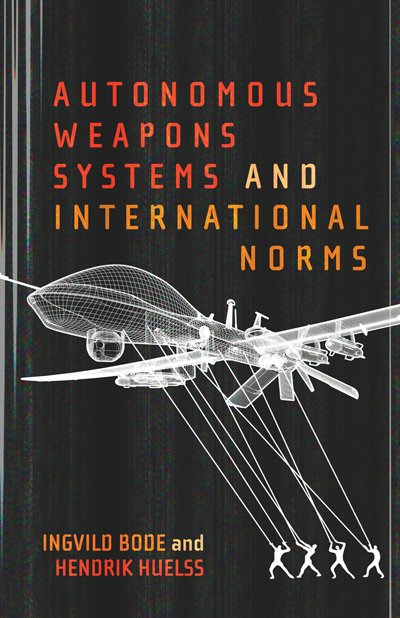
Autonomous Weapons and International Norms
By: Ingvild Bode and Hendrik Huelss
Published in: Toronto: McGill-Queen’s University Press
Date: 2022
Summary
In Autonomous Weapons Systems and International Norms Ingvild Bode and Hendrik Huelss present an innovative study of how testing, developing, and using weapons systems with autonomous features shapes ethical and legal norms, and how standards manifest and change in practice. Autonomous weapons systems are not a matter for the distant future – some autonomous features, such as in air defence systems, have been in use for decades. They have already incrementally changed use-of-force norms by setting emerging standards for what counts as meaningful human control. As UN discussions drag on with minimal progress, the trend towards autonomizing weapons systems continues.
Individual Agency and Policy Change at the United Nations: The People of the United Nations
By: Ingvild Bode
Published in: London – Routledge
Date: 2015
Summary
This book highlights how temporary international civil servants play a crucial role in initiating processes of legal and institutional change in the United Nations system. These individuals are the “missing” creative elements needed to fully understand the emergence and initial spread of UN ideas such as human development, sovereignty as responsibility, and multifunctional peacekeeping.
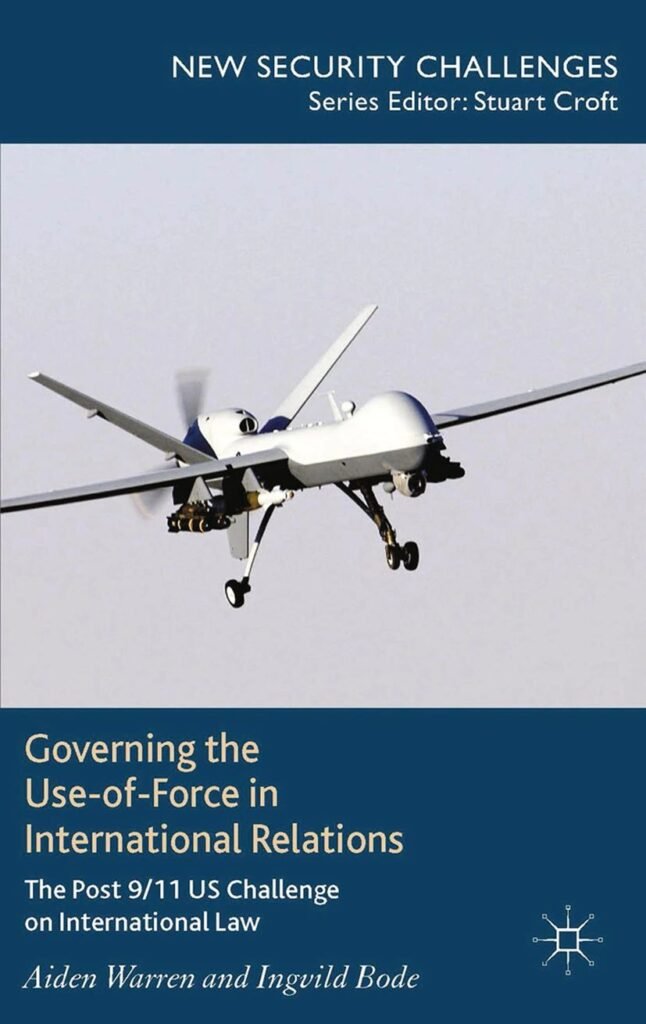
Governing the Use-of-Force in International Relations: The Post-9/11 US Challenge to International Law
By: Aiden Warren and Ingvild Bode
Published in: Basingstoke – Palgrave Macmillan
Date: 2014
Summary
This book examines US recourse to military force in the post-9/11 era. In particular, it evaluates the extent to which the Bush and Obama administrations viewed legitimizing the greater use-of-force as a necessary solution to thwart the security threat presented by global terrorist networks and WMD proliferation.
Other publications
A selection of book chapters, policy breifs and reports, and submissions of evidence.
For a full list of publications, se below.
Use of Force in Peace Operations
By: Ingvild Bode
Published in: Oliver Richmond and Gëzim Visoka (eds) The Palgrave Encyclopaedia of Peace and Conflict Studies (PEPCS). Online only.
Date: 2020
Summary
This encyclopaedic entry discusses how and whether to integrate the use of force in United Nations (UN) peace operations, and addresses the fundamental questions about their overall purpose.
Expertise as Social Practice: The Individual Construction of Experts
By: Ingvild Bode
Published in: Christian Henrich-Franke, Christian Lahusen, Robert Kaiser, and Andrea Schneiker (eds) Transnational Expertise (Baden-Baden: Nomos), pp. 101-126.
Date: 2018
Type: Chapter in book
About the book
This edited volume is devoted to analysing transnational expertise, a topic that has received considerable attention in the social sciences and history, especially in research on transnational professional networks and associations, epistemic communities and groups of practitioners. Yet more knowledge about transnational expertise is needed, given the growing importance of expertise in an ever more complex world in which interdependencies between different types of actors and organisations are increasing and in which these actors often have to cooperate to address transnational issues. While studies regarding the above-mentioned concepts have generally involved empirical cases of expertise in the context of transnational governance since the end of the Cold War, transnational expertise actually played an important role long before 1990. Therefore, this volume adopts an interdisciplinary approach that includes perspectives from history, sociology and political science.
List of Publications
Books
Ingvild Bode and Hendrik Huelss. 2022 Autonomous Weapons and International Norms (Toronto: McGill-Queen’s University Press). Available here.
Ingvild Bode. 2015. Individual Agency and Policy Change at the United Nations: The People of the United Nations (London: Routledge). Available here.
Aiden Warren and Ingvild Bode. 2014. Governing the Use-of-Force in International Relations: The Post-9/11 US Challenge to International Law. (Basingstoke: Palgrave Macmillan). Available here.
Journal Articles
Ingvild Bode and Hendrik Huelss. (2024). “Artificial Intelligence Technologies and Practical Normativity/Normality: Investigating Practices Beyond the Public Space”. Open Research Europe, https://doi.org/10.12688/openreseurope.16536.2
Tom Watts and Ingvild Bode. (2024). “Machine Guardians: The Terminator, AI Narratives, and US Regulatory Discourse on Lethal Autonomous Weapon Systems”. Cooperation & Conflict 59 (1), 107-128.
Ingvild Bode, Hendrik Huelss, Anna Nadibaidze, Guangyu Qiao-Franco & Tom Watts. (2024). “The Study of Algorithmic Warfare: Taking Stock of a Research Programme”. Global Society 38 (1), 1-23.
Ingvild Bode. (2024). “Emergent Normativity: Community of Practices, Technology, and Autonomous Weapons.” Part of a Special Issue on Communities of Practice (edited by Maika Sondaarje, Niklas Bremberg, and Emanuel Adler). Global Studies Quarterly 4(1): https://doi.org/10.1093/isagsq/ksad073.
Ingvild Bode and Hendrik Huelss. (2023). “Technologische Herausforderungen: Künstliche Intelligenz, Normativität, Normalität und Praktiken jenseits des öffentlichen Raums.” (Technological Challenges: Artificial Intelligence, Normativity, Normality, and Practices Beyond the Public Space). Zeitschrift für International Beziehungen 30(2): 124-134. [in German]
Ingvild Bode. (2023). “Practice-based and Public-Deliberative Normativity: Retaining Human Control over the Use of Force”. European Journal of International Relations 29(4): 990-1016. https://doi.org/10.1177/13540661231163392.
Ingvild Bode. (2023). “Contesting Use-of-Force Norms through Technological Practices”. Heidelberg Journal of International Law 83(1), 39-64. Link.
Ingvild Bode, Hendrik Huelss, Anna Nadibaidze, Guangyu Qiao-Franco, and Thomas Watts. (2023). “Prospects for the Global Governance of Autonomous Weapons: Comparing Chinese, Russian, and US Practices”. Ethics & Information Technology 25, DOI: 10.1007/s10676-023-09678-x.
Rockwell Clancy, Qin Zhu, and Ingvild Bode. (2023). “The Need for and Nature of a Normative, Cultural Psychology of Weaponised AI”. Ethics & Information Society 25, DOI: 10.1007/s10676-023-09680-3.
Ingvild Bode and Hendrik Huelss. (2023) “Constructing Expertise? The Front- and Back-Door Regulation of AI’s Military Applications in Europe” Journal of European Public Policy. 30(7), 1230-1254. https://doi.org/10.1080/13501763.2023.2174169.
Guangyu Qiao-Franco and Ingvild Bode. (2023) “Lethal Autonomous Weapon Systems and Chinese Practices of Human-Machine Interaction”. Chinese Journal of International Politics. Online first. https://doi.org/10.1093/cjip/poac024.
Ingvild Bode. 2020. ‘Women or Leaders? Practices of Narrating the United Nations Secretariat as a Gendered Institution’. International Studies Review 22 (1), 347-369. First published online: 01/2019.
Ingvild Bode. 2019. ‘Norm-making and the Global South: Attempts to Regulate Lethal Autonomous Weapons Systems.’ Global Policy 10 (3), 359-364.
Ingvild Bode and Hendrik Huelss. 2019. ‘Introduction to the Special Section: The Autonomisation of Weapons Systems: Challenges to International Relations.’ Global Policy 10 (3), 327-330. [editorial]
Ingvild Bode and John Karlsrud. 2019. ‘Implementation in Practice: The Use of Force to Protect Civilians in Peacekeeping Operations.’ European Journal of International Relations 25 (2), 458-485. First published online: 10/2018. Open access.
Andrea den Boer and Ingvild Bode. 2018. ‘Gendering Security: Connecting Theory and Practice.’ Global Society 32 (4), 365-373. [editorial]
Ingvild Bode and Hendrik Huelss. 2018. ‘Autonomous Weapons Systems and Changing Norms’. Review of International Studies 44 (3), 393-413. First published online: 02/2018. Open Access.
Ingvild Bode. 2018. ‘Reflective Practices at the Security Council: Children and Armed Conflict and the Three United Nations.’ European Journal of International Relations 24(2). First published online: 08/2017. Open Access
Ingvild Bode and Seunghoon Emilia Heo. 2017. ‘World War II Narratives in Contemporary Germany and Japan: How University Students Understand Their Past.’ International Studies Perspectives 18 (2), 131-154. First published: 12/2016.
Aiden Warren and Ingvild Bode. 2015. ‘Altering the Playing Field: The US Redefinition of the Use-Of-Force from Bush to Obama.’ Contemporary Security Policy 36(2), 174-199.
Ingvild Bode. 2015. ‘Akteure des Stillstands oder des Wandels? Die Einflussmöglichkeiten von UN-Bediensteten auf Prozesse des Politikwandels in den UN.’ (Agents of Change or Agents of the Status Quo? The Influence Possibilities of UN Officials on Processes of Chance in the United Nations) [in German] Vereinte Nationen 1/2015, 257-62.
Ingvild Bode. 2014. ‘Francis Deng and the Concern for Internally Displaced Persons: Intellectual Leadership in the United Nations.’ Global Governance 20(2), 277-298. [peer-reviewed]
Other Publications
Book chapters
Ingvild Bode & Hendrik Huelss. [Forthcoming]. “Artificial Intelligence and the Production of Knowledge and Expertise in International Relations”. In: Berit Bliesemann de Guevara, Katarzyna Kaczmarska, Xymena Kurowska, Birgit Poopuu, and Andrea Warnecke (eds.) Oxford Handbook of Knowledge and Expertise in International Politics (Oxford: Oxford University Press).
Ingvild Bode and Shimona Mohan. [Forthcoming]. “Narratives and Imaginations of Weaponised Artificial Intelligence Technologies in India”. In: Christian Baechle and Jascha Bareis (eds) The Realities of Autonomous Weapons, Bristol University Press.
Ingvild Bode and Guangyu Qiao-Franco. [Forthcoming]. ”AI Geopolitics and International Relations: A Divided World Behind Contested Conceptions of Human Control”. In: Regine Paul, Emma Carmel, and Jennifer Cobbe (eds) Handbook on Public Policy and AI, Edward Elgar.
Ingvild Bode and Anna Nadibaidze. [Forthcoming]. “Autonomous Drones”. In: James Rogers (ed). The De Gruyter Handbook on Drone Warfare (Berlin & Boston: De Gruyter).
Ingvild Bode. 2020. ‘Use of Force in Peace Operations.’ In Oliver Richmond and Gëzim Visoka (eds) The Palgrave Encyclopaedia of Peace and Conflict Studies (PEPCS). Online only. https://doi.org/10.1007/978-3-030-11795-5_83-1.
Ingvild Bode. 2020. ‘Practice Theories.’ In Kseniya Oksamytna and John Karlsrud (eds) United Nations Peace Operations and International Relations Theory (Manchester: Manchester University Press), pp. 129-148. [peer-reviewed]
Ingvild Bode. 2018. ‘Expertise as Social Practice: The Individual Construction of Experts.’ In Christian Henrich-Franke, Christian Lahusen, Robert Kaiser, and Andrea Schneiker (eds) Transnational Expertise (Baden-Baden: Nomos), pp. 101-126.
Ingvild Bode. 2017. ‘Manifestly Failing and Unable or Unwilling as Intervention Formulas: A Critical Analysis.’ In Aiden Warren and Damian Grenfell (eds) Rethinking Intervention: Security and the Limits of Humanitarian Intervention (Edinburgh: Edinburgh University Press), pp. 164-191. [peer-reviewed]
Ingvild Bode. 2014. ‘Storytelling in den Vereinten Nationen: Mahbub ul Haq und menschliche Entwicklung’ (Storytelling at the United Nations: Mahbub ul Haq and Human Development) [in German] In Frank Gadinger, Sebastian Jarzebski, and Taylan Yildiz (eds) Political Narratives: Possibilities for an Analytical Concept in Political Science (Wiesbaden: Springer), pp. 339-362.
Volker Rittberger, Julian Bergmann, and Ingvild Bode. (eds) 2010. Wer regiert die Welt und mit welchem Recht (Who Rules the World and With Whose Authority?) [in German] (Baden Baden: Nomos).
Ingvild Bode. 2009. ‘Empowered Individuals – Individual Agency in Global Governance.’ In: Arie M. Kacowicz (ed.) In the Spirit of Einstein: Germans and Israelis on Ethics and International Order (Hebrew University of Jerusalem: The Leonard Davis Institute for International Relations & the Einstein Centre), pp. 31-44.
Policy briefs and reports
Ingvild Bode and Tom Watts. 2023. “Loitering Munitions and Unpredictability: New Challenges to Human Control”. Centre for War Studies. Link.
Ingvild Bode and Tom Watts. 2021. “Meaningless Human Control: Lessons from Air Defence Systems for the Debate on Autonomous Weapons”. Published by Centre for War Studies and Drone Wars UK. Link.
Ingvild Bode and Hendrik Huelss. 2017. ‘Implications of Lethal Autonomous Weapons Systems for International Peace and Security.’ Policy brief circulated in advance of the First Group of Governmental Experts (GGE) on LAWS at the Convention on Certain Conventional Weapons in Geneva (Centre for the Analysis of International Conflicts, University of Kent: Canterbury).
Submissions of evidence
Ingvild Bode, Hendrik Huelss, and Anna Nadibaidze. 2023. Written Evidence to the UK House of Lords Select Committee “AI in Weapon Systems”. Link.
Ingvild Bode, Hendrik Huelss, Anna Nadibaidze, Guangyu Qiao-Franco, Tom Watts. 2021. Written Contribution by the AutoNorms project. Group of Governmental Experts (GGE) on Emerging Technologies in the Area of Lethal Autonomous Weapon Systems. Link.
Ingvild Bode. 2021. Written Evidence on the future norms of warfare to the project “The Future Rules of Warfare” by the Royal United Services Institute (RUSI). Link.
Ingvild Bode, Anna Nadibaidze, Hendrik Huelss & Tom Watts. 2021. Written Evidence to UK House of Commons Foreign Affairs Enquiry on “Tech and the future of UK foreign policy”. Link. Update 07/2022: Evidence cited in House of Commons Foreign Affairs Committee. 2022. “Encoding Values: Putting Tech at the Heart of UK Foreign Policy”. Third Report of Session 2022/2023. HC 170, p. 19. Link.